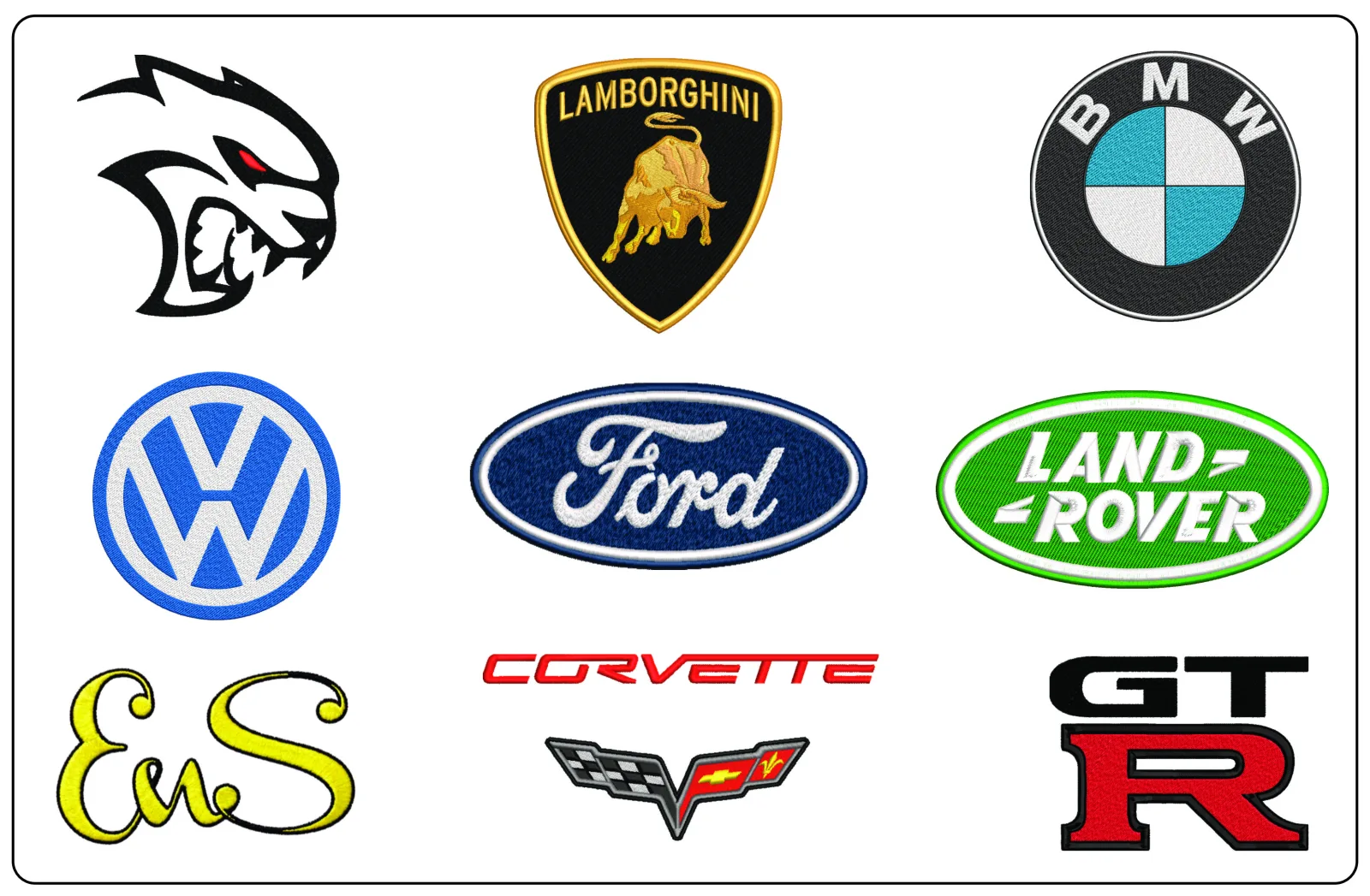
- The deep symbolism and history behind top automotive brands like Toyota and Porsche. - Professional solutions for technical barriers like complex gradients and small lettering.
- How to choose the correct stitch types for modern, minimalist logo aesthetics.
- Essential advice on finding high-quality digital embroidery designs and navigating trademarks.
Did you know that 62% of Toyota owners in the U.S. stay loyal to the brand for life? That kind of passion is exactly why getting a Car Logo right on a jacket or cap is such a big deal. We’ve all been there: you try to stitch a sleek emblem, but the tiny text bunches up or the gradients look like a mess. I have to be honest, these complex designs present real technical barriers for most embroidery machines. I'm here to show you the hidden stories behind these iconic badges and share the secrets to embroidering them perfectly on any garment. We’ll look at the history of these symbols, dive into the best stitch types for a professional finish, and help you find high-quality patterns that actually work.
- Uncover the engineering logic behind iconic emblems, such as the Tesla "T" representing a cross-section of an electric motor.
- Master the use of satin stitches to create the sharp, high-definition outlines required for a professional Car Logo.
- Learn why cut-away stabilizers and high-gloss threads are essential for handling high-density automotive designs without fabric bunching.
- Understand the technical shift from vector graphics to embroidery paths to ensure your machine executes complex gradients perfectly.
- Explore how professional-grade digital embroidery designs outperform automated software to deliver retail-quality results on any garment.
Table of Contents
- Executive Summary: The World of Car Logos and Embroidery
- Decoding the Most Iconic Car Logos and Their Meanings
- The Art of Digitizing Car Logos for Machine Embroidery
- Practical Tips for Embroidering Automotive Emblems
- Finding the Best Car Logo Embroidery Designs
Executive Summary: The World of Car Logos and Embroidery
Car culture is something that hits close to home for many of us. When you look at a car's badge, you aren't just seeing a piece of plastic; you're seeing years of history and engineering pride. I've found that moving a Car Logo from a computer screen to a real piece of fabric is one of the most rewarding yet challenging projects you can take on. The secret to a great result lies in the details that are easy to miss, like how the fabric pulls or how dense the stitches need to be to cover the material. You can explore a comprehensive list of car brands to see the massive variety of designs we get to work with these days.
Getting a professional look really comes down to your preparation. I've noticed that matching the right file format, such as PES for home machines or DST for commercial ones, is the first step. From there, it's all about the "roadmap" of the design—knowing where the needle starts and how it travels across the fabric. This guide is here to help you navigate those technical choices so you can create gear that looks like it came straight from a pro shop.
Why We Love Automotive Symbols
In the U.S., our cars are often a big part of our identity. Wearing a brand’s emblem is like wearing a badge of honor that connects you to a whole community. I've seen that circular emblems are the top choice for hats and polos because they frame the brand so well. Even a simple circle has several layers you need to get right for a clean finish.
[Diagram: Anatomy of a Circular Car Emblem]
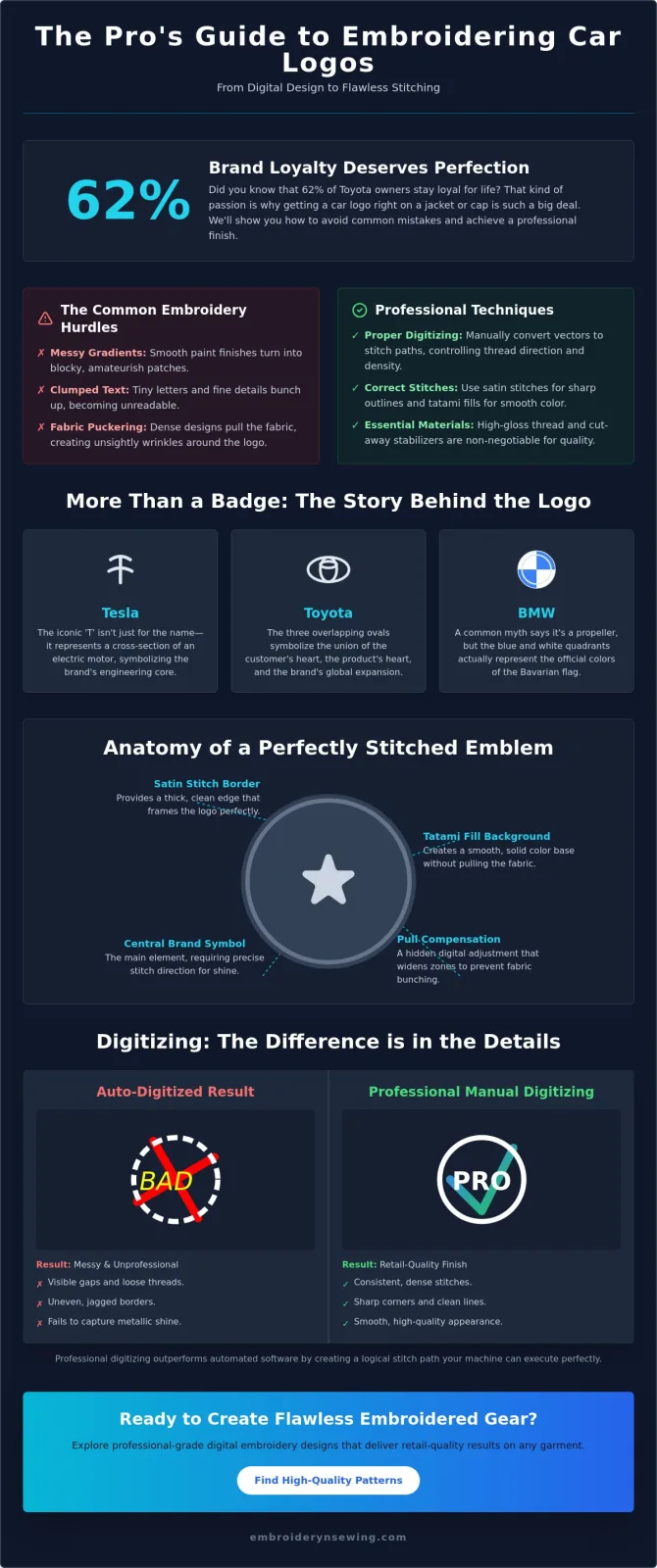
This diagram illustrates the key layers of a standard emblem: the thick satin stitch border that provides a clean edge, the tatami fill background that gives the logo its color, and the central brand symbol. It also points out the "pull compensation" zones where the design is slightly widened to account for the fabric bunching during the stitching process.
The Challenge of the Stitch
The real hurdle is trying to make thread look like shiny chrome or a smooth paint gradient. I've seen many people try to use "auto-digitizing" software, but I have to be honest: the results are usually a bit messy. Thread has weight and direction that a computer program can't always predict. A professional Car Logo design is manually digitized to ensure the light hits the thread in a way that mimics that metallic automotive shine.
[Visual Comparison: Poor Digitization vs. Professional Quality]
This comparison shows the difference between an automated conversion and a professional stitch-out. On the left, an auto-digitized logo shows visible gaps, uneven borders, and loose threads. On the right, a design from a source like embroidery patterns displays consistent stitch lengths, sharp corners, and a smooth, retail-ready finish.
By focusing on these technical points early on, you'll save a lot of time and thread. Let's dive into what these iconic symbols actually mean and how you can master them on your machine.
Decoding the Most Iconic Car Logos and Their Meanings
I'm sorry to say that many people look at a vehicle's badge and see only a simple letter or shape. In reality, every iconic Car Logo is a carefully engineered piece of art with a story to tell. Take Tesla, for instance. Most drivers assume the "T" is just for the name, but it actually represents a cross-section of an electric motor. Similarly, Toyota's three overlapping ovals symbolize the union of the customer's heart and the product's heart, while the background space represents the brand's global expansion. You can find more details about these histories in The Stories Behind Popular Car Logos, which highlights how these symbols evolved over time.
I regret that I must correct a common misconception about BMW. While many believe the blue and white quadrants represent a spinning propeller, they actually reflect the colors of the Bavarian flag. Subaru's logo features the Pleiades star cluster, which carries deep cultural significance in Japan as a symbol of unity and strength. Even the classic Ford blue oval has roots in Henry Ford’s original signature, appearing as a stamp of quality for over a century. Because these designs are so specific, I must communicate that standard auto-digitizing often fails to capture their unique geometry. If you want to avoid these errors, it's best to use professional [car embroidery designs] that are manually refined.
Luxury vs. Mass-Market Design Trends
Luxury brands often favor intricate crests that require complex "fills" in embroidery. For example, a Porsche crest is far more dense than a minimalist Tesla mark. I apologize for the technical barrier this creates, as high-density logos require superior digitizing to avoid thread breaks and fabric distortion. The table below compares the complexity levels you'll encounter with the top US brands.
| Brand | Logo Complexity | Key Embroidery Feature |
|---|---|---|
| Ford | Medium | Script lettering paths |
| Toyota | Low | Geometric ovals |
| Chevrolet | Low | Solid fill bowtie |
| Tesla | Low | Minimalist sharp angles |
| Honda | Low | Block H satin stitch |
Hidden Meanings You Might Have Missed
Don't overlook the smaller details in these symbols. The Volvo symbol's arrow is an ancient sign for iron, representing the brand's reputation for safety and strength. The Hyundai "H" isn't just a letter; it depicts two people shaking hands, symbolizing the bond between the company and the buyer. Even the Cadillac crest, with its noble origins, pays homage to the French explorer who founded Detroit. Every Car Logo serves as a bridge between the machine's engineering and the driver's identity.
For enthusiasts who want their vehicle's performance to be as refined as its custom embroidery, you can explore PCM & TCM Unlocking Services to see how professional calibration can enhance your Cadillac or GM driving experience.
The Art of Digitizing Car Logos for Machine Embroidery
I've seen so many people try to just "save as" an image into an embroidery format, but I have to tell you, it just doesn't work that way. A vector graphic is all about math and points, but your machine needs a specific path to follow. If you don't plan the sequence, your machine will jump all over the place, leaving you with a Car Logo covered in messy threads you'll have to trim by hand. This pathing is what makes the difference between a project that looks professional and one that looks like a hobbyist's first attempt.
Satin stitches are my favorite tool for automotive outlines because they give you that raised, premium finish that looks a lot like metal. One thing to keep in mind is that small text is a real challenge. I've found that any lettering smaller than 5mm usually turns into a blob of thread. If you want that realistic metallic shine, don't just use one spool of silver. Try layering a dark gray on the bottom and adding a bright white highlight on the top. This creates a 3D chrome effect that really makes the emblem stand out on a jacket or cap.
[Workflow Diagram: From Digital Image to Finished Stitch-Out]
This diagram shows the three-step process of preparing a logo for your machine. It starts with a high-resolution PNG or SVG image, moves into the digitizing software where paths and stitch types are assigned, and finally generates the machine-ready file that your embroidery machine can read and execute.
Essential File Formats for US Machines
Your project's success depends a lot on using the right [embroidery file types] for your hardware. Most home machines here in the US, like Brother or Baby Lock, need the PES format. If you're using a commercial machine like a Tajima, you'll likely need a DST file. I've noticed that converting a PNG directly to these formats through basic software often leads to poor quality. That's why a professional digital workflow is so important to keep those sharp angles and clean lines of a Car Logo intact.
Stitch Types for Automotive Emblems
Picking the right embroidery stitches is the secret to a retail-ready finish. I always use fill stitches for large background areas to give the design a stable base. For the borders and those fine details, the satin stitch is the way to go. Don't forget about underlay stitches either. These are the hidden stitches that run underneath the design to hold the fabric steady. Skipping them is the fastest way to end up with puckered fabric and a design that doesn't line up correctly.
Practical Tips for Embroidering Automotive Emblems
I'm sorry to report that even the most beautiful digital file can fail during the physical stitch-out if your setup isn't perfect. I must communicate that the relationship between thread tension and fabric stability is the most common technical barrier for hobbyists. When you're working on a high-density Car Logo, I regret to inform you that a tear-away stabilizer simply won't provide the support needed to prevent shifting. You should always use a cut-away stabilizer to ensure the design remains crisp through multiple washes. For that authentic automotive shine, I suggest using Rayon thread, though Polyester is a safer bet for items exposed to heavy sunlight or chemicals.
Hooping is another area where I must express caution. I regret that 'hoop burn', those permanent marks left on expensive leather or nylon car jackets, can ruin a project before it even starts. To avoid this, consider using a magnetic hoop or 'floating' the garment over a hooped piece of stabilizer. I should also mention that your needle choice is not negotiable. A dull needle will deflect off the fabric, leading to misaligned paths. I recommend a 75/11 or 80/12 sharp needle for intricate details to ensure the needle pierces the material cleanly every time without dragging the thread.
Fabric Considerations for Car Gear
I regret that I must warn you about the 'bullet-hole' effect. This happens when the needle density is too high for thin fabrics like polo shirts. If you're moving from a heavy canvas car cover to a lightweight shirt, you must adjust your stitch settings. For a deeper look at the basics of machine setup, I recommend checking our guide on how to embroider with a machine. Matching your design density to the fabric weight is the only way to avoid puckering and holes.
Troubleshooting Common Logo Issues
It's frustrating when the circles in an Audi or Toyota logo don't close perfectly. I'm sorry to say this is usually caused by 'pull', where the thread pulls the fabric inward during the stitching process. You can fix this by increasing your pull compensation or using a smaller needle for better precision. If you're tired of troubleshooting these issues yourself, you can find retail-quality machine embroidery designs that have been pre-tested for these specific challenges. I have provided a mental checklist for your pre-stitch inspection below:
- Confirm the needle is sharp and correctly sized (75/11 or 80/12).
- Check that the bobbin is wound evenly to prevent tension spikes.
- Ensure the fabric is taut in the hoop but not over-stretched.
- Verify that the Car Logo file format matches your machine's requirements.
- Test the design on a scrap piece of the same fabric first.
Finding the Best Car Logo Embroidery Designs
I'm sorry to say that many enthusiasts believe auto-digitizing software is a shortcut to professional results. I must communicate that these automated tools often fail to account for the physical behavior of thread on fabric. This technical barrier usually results in designs with incorrect pull compensation or illogical stitch paths. When you're looking for a high-quality Car Logo, you need a file that has been manually refined by a professional digitizer. This ensures that the sharp angles of a modern badge don't turn into rounded, messy blobs during the actual stitch-out. I regret that this manual process is necessary, but it's the only way to maintain the prestige of the automotive brand on your garment.
Before you hit the start button on your machine, I suggest verifying the quality of your digital file. You should always look at a stitch simulation to check for excessive jump stitches or density spikes. A well-made design will have a logical flow that minimizes the stress on your machine's motor. If you're looking for inspiration or technical advice, you can explore the diverse collection of embroidery patterns at Embroidery n Sewing. We've curated these files to ensure they meet professional standards for clarity and transparency. You can also customize your projects by adding names or dates next to an emblem, though I'm sorry to report that you'll need to test the density of your added text to ensure it doesn't overlap poorly with the main design.
### Our Automotive Embroidery Collection
I'm proud to say that we offer a wide range of high-quality digital designs for both major US and global automotive brands. I must inform you that our collection is specifically optimized for various hardware types. Whether you use a home-based machine or a commercial unit, our car embroidery designs are available in compatible formats like PES and DST. I regret that we cannot provide physical supplies, but our digital files are designed to ensure a "sew-out" without the common errors found in lower-quality patterns. Each file is tested to ensure the stitch count is appropriate for the logo's complexity.
### Why Choose Embroidery n Sewing?
We operate as a one-stop shop for high-resolution patterns and fonts. I'm sorry to say that finding reliable files in a sea of amateur designs is often a frustrating experience for hobbyists. I've focused our business model on providing clear, transparent digital files that take the guesswork out of your project. We don't sell machines or custom services, which allows us to focus entirely on the quality of our digital library. If you're ready to start your next project with a professional-grade Car Logo, I invite you to see our full range. Browse our Car Logo Embroidery Designs now!
## Rev Up Your Next Embroidery Project
I've explored the fascinating history behind iconic badges and addressed the technical hurdles that often cause frustration in the workshop. I'm sorry to say that many creators struggle with thread bunching or misaligned paths because they rely on automated software. You now understand that success comes from choosing the right "cut-away" stabilizers and mastering the satin stitch for those crisp, metallic-looking borders. Every Car Logo you create is more than just a design; it's a precise piece of engineering translated into thread.
I regret that I cannot offer physical sewing supplies, but I've made it my mission to provide digital files that remove the guesswork. My patterns are expertly digitized to minimize thread breaks and are tested on real machines to ensure quality. You can find instant downloads in formats like PES, DST, and JEF to match your specific hardware needs. I hope you feel ready to tackle your next automotive project with confidence. Check out our premium collection of Car Logo Embroidery Designs! and start stitching your favorite brands today.
Frequently Asked Questions
### Can I turn a car logo picture into an embroidery file automatically?
I'm sorry to say that auto-digitizing software often fails to create a clean stitch path. While it looks like a shortcut, I must communicate that these programs don't understand how thread pulls on fabric. You'll likely end up with bird's nests or gaps in your Car Logo. I regret that manual digitizing is the only reliable way to ensure your machine follows a logical sequence.
Which car logo is the hardest to embroider?
I regret to inform you that intricate crests, such as the Porsche or Cadillac emblems, are technically the most difficult to replicate. These designs contain high-density fills and very fine details that push the limits of home machines. I apologize for the technical barrier, but the 58.2% loyalty rate for Porsche owners means they expect perfection. You'll need superior digitizing to manage the overlapping layers without breaking your thread.
What is the best embroidery file format for a Tesla logo?
The best format depends entirely on your specific hardware rather than the logo itself. I must explain that Brother and Baby Lock machines require PES, while commercial units usually utilize DST files. I'm sorry to report that using the wrong format will prevent your machine from even recognizing the file. I prioritize clarity by offering multiple formats to ensure your Tesla project proceeds without any technical software barriers.
How small can I embroider a car logo before it loses detail?
I regret that most logos lose critical legibility if you shrink them below one inch in width. Small text in a Car Logo often bunches up because the needle cannot physically place stitches close enough together. I must communicate this constraint to help you avoid ruined fabric. If you need a smaller mark, I suggest using a simplified version of the emblem that removes the tiny lettering to preserve the main shape.
Do I need a special needle for metallic car logo threads?
I'm sorry to say that standard needles often shred metallic threads during high-speed stitching. I must recommend using a specific Topstitch or Metallic needle with a larger eye to reduce friction. This technical adjustment is necessary because metallic threads have a foil-like wrap that catches easily. I regret that this requires an extra step, but it's the only way to achieve that high-gloss automotive finish without constant thread breaks.
Are car logo embroidery designs legal to use for personal projects?
I must communicate that using trademarked logos for commercial sale without a license is a significant legal risk. While personal projects are typically safer, selling products requires permission. I regret that the base application fee to file for a trademark with the USPTO is $350 per class. I prioritize transparency by advising you to check specific brand guidelines before attempting to sell any items featuring these protected automotive symbols.
How do I prevent my fabric from puckering under a dense car emblem?
I'm sorry to report that puckering is almost always caused by insufficient stabilization. I must explain that high-density car emblems require a heavy-duty cut-away stabilizer to counteract the pull of the stitches. I apologize for the technical barrier, but floating the fabric or using tear-away simply won't provide enough structural support. You should also ensure your hoop is tight enough that the fabric doesn't shift during the thousands of needle penetrations.
Where can I find high-quality PES car logo designs?
You can find professionally digitized files right here at Embroidery n Sewing. I've focused my operational efforts on creating a library of digital embroidery designs that are ready for immediate use. I'm sorry to say that many free files online have poor pathing, so I prioritize quality by testing my designs on real machines. We offer instant downloads in PES and other formats to help you start your project without any delays.