Dreaming of bringing your creative designs to life with thread but feeling lost in a sea of technical terms? If talk of hoop sizes, file formats, and stitch counts makes you more nervous than excited, you are not alone. The fear of investing in a machine that's too complicated-or one you'll outgrow in a month-is a major hurdle for many aspiring creators. That's why we've poured hours into research and hands-on testing to find the absolute best embroidery machine for beginners 2026.
Forget the confusion and analysis paralysis. In this honest guide, we're cutting through the noise to help you start your embroidery journey with confidence. We’ll demystify the essential features, reveal our top picks for reliable and user-friendly models at every price point, and give you a clear path from unboxing your machine to stitching your very first project. Get ready to choose the perfect creative partner without the stress.
- Identify the four non-negotiable features your first embroidery machine must have to avoid common frustrations. - Discover our top picks for the best embroidery machine for beginners 2026, tailored to different budgets and project goals.
- Master the crucial first steps after unboxing your machine to start stitching your first project successfully. - Understand how to use digital embroidery designs to unlock endless creative possibilities beyond the built-in patterns.
Table of Contents
- Before You Buy: 4 Key Features Every Beginner Embroidery Machine Needs
- Our Top 5 Embroidery Machines for Beginners in 2026
- You Bought a Machine! What Happens Next?
- Unlocking Your Creativity with Digital Embroidery Designs
Before You Buy: 4 Key Features Every Beginner Embroidery Machine Needs
Full disclosure: we specialize in creating beautiful, high-quality embroidery designs, not selling the machines themselves. Our goal is to empower you with the right knowledge so you can confidently choose a machine that will bring our patterns to life without frustration. Navigating the market for the best embroidery machine for beginners 2026 can be overwhelming, with dozens of models and features to consider. While the history of machine embroidery shows a rapid evolution in technology, there are a few core features that truly matter for a new user. Focus on these four essentials to avoid confusion and prevent buyer's remorse.
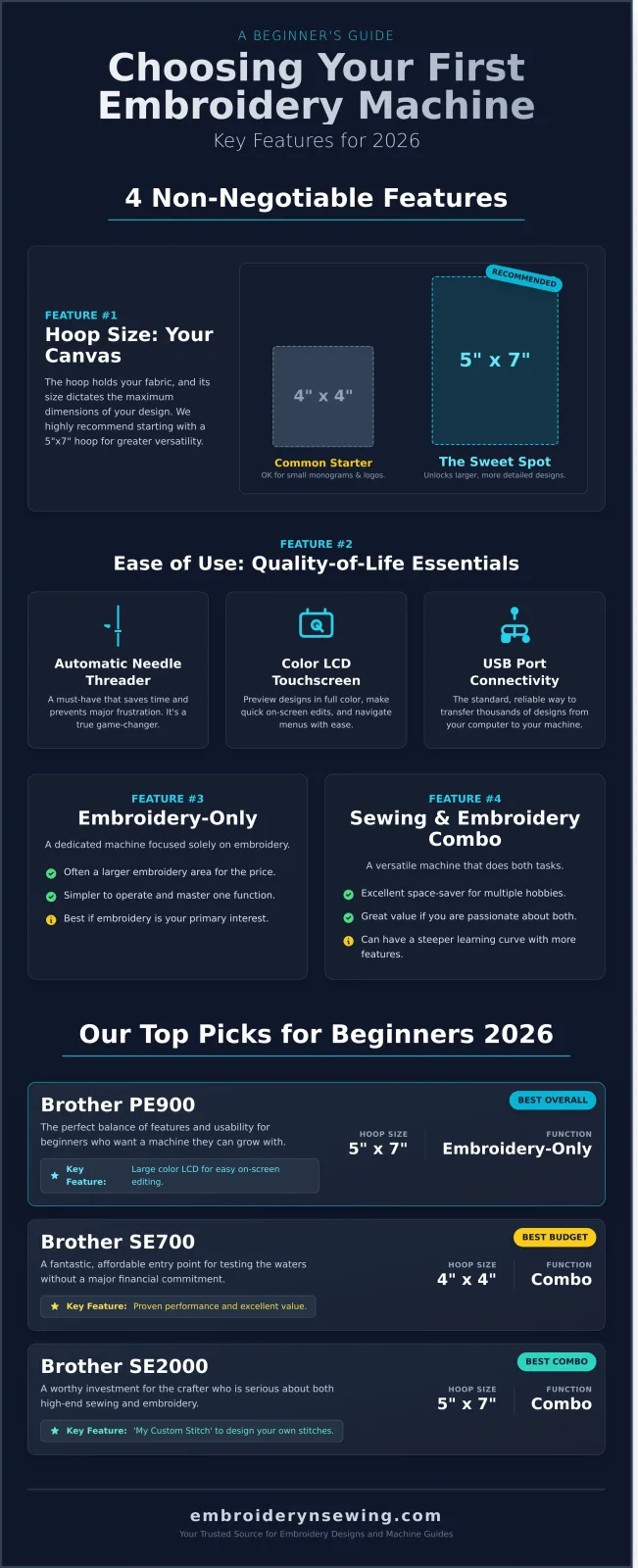
The embroidery hoop is the frame that holds your fabric taut while the machine stitches. Its size dictates the maximum dimensions of any single design you can create. While a 4x4 inch hoop is a common starting point and works well for small monograms or logos, we highly recommend looking for a machine that includes at least a 5x7 inch hoop. This "sweet spot" offers far more versatility, allowing you to tackle larger, more intricate designs without being forced to split them. Keep in mind that larger hoop capabilities almost always mean a higher price tag.
Ease of Use: Look for These Features
Your first machine should make your new hobby enjoyable, not a chore. Certain quality-of-life features are non-negotiable for a smooth learning curve. When comparing models, prioritize these three things:
- Automatic Needle Threader: This is a must-have. It saves an incredible amount of time and frustration, especially for those with less-than-perfect eyesight.
- Color LCD Touchscreen: A clear, responsive color screen allows you to preview your designs, make simple edits like rotating or resizing, and easily navigate the machine’s functions.
- USB Port Connectivity: This is the standard, reliable way to load designs you purchase online (like ours!) onto your machine. While Wi-Fi is a nice bonus, a simple USB port is essential.
Embroidery-Only vs. Sewing-Embroidery Combo
One of the biggest decisions is whether to get a dedicated embroidery machine or a combination sewing and embroidery unit. An embroidery-only machine often provides a larger embroidery area for the price and can be simpler to operate. A combo machine is an excellent space-saver if you are passionate about both hobbies. The key is to consider your primary interest. If you see yourself mostly embroidering, a dedicated machine might be a better fit. Many beginners find it easier to master one function at a time.
Our Top 5 Embroidery Machines for Beginners in 2026
After extensive research into reliability, user-friendliness, and community feedback, we've curated this list of the top embroidery machines for new hobbyists in Doha. We've considered different budgets and needs, from those just dipping their toes in the water to those ready for a more serious investment. To select the best embroidery machine for beginners 2026, we at Embroidery n Sewing evaluated which models provide the smoothest learning curve. For broader learning and community support, engaging with local craft enthusiasts in Doha or exploring online communities can be invaluable as you start your journey. Rest assured, every machine on our list is compatible with standard design formats like PES and DST, so you can easily find or buy designs online.
Best Overall for Beginners: Brother PE900
The Brother PE900 hits the sweet spot for beginners who want a machine they can grow with. Its generous 5" x 7" embroidery area is a significant step up from entry-level 4x4 hoops, allowing you to create larger, more complex designs without needing to upgrade right away. The large color touchscreen makes editing designs on-screen intuitive, and with 193 built-in designs, you can start creating the moment you set it up. Note that this is a dedicated embroidery-only machine, making it a focused and powerful tool for the craft.
- Hoop Size: 5" x 7"
- Function: Embroidery-Only
- Key Feature: Large color LCD screen
Best Budget-Friendly Starter: Brother SE700
If you're looking for an affordable entry point, the Brother SE700 is a fantastic choice. As the successor to the wildly popular SE600, this sewing and embroidery combo machine offers proven performance at a price that's perfect for testing the waters. The 4" x 4" hoop is ideal for personalizing clothes, towels, and small gifts. It's the perfect machine to learn the basics on without a major financial commitment.
- Hoop Size: 4" x 4"
- Function: Sewing & Embroidery Combo
- Key Feature: Excellent value for beginners
Best Combo Machine for Versatility: Brother SE2000
For the crafter who is serious about both sewing and embroidery, the Brother SE2000 is a worthy investment. It combines the advanced features of a high-end sewing machine with a spacious 5" x 7" embroidery field. Sewers will love the 'My Custom Stitch' feature, which lets you design your own unique stitches. While it has a higher price point, it effectively replaces two separate machines, offering incredible versatility and power in a single unit.
- Hoop Size: 5" x 7"
- Function: Sewing & Embroidery Combo
- Key Feature: Advanced sewing and design editing features
A Great Alternative Brand: Janome Memory Craft 550E
While Brother often dominates the beginner market, the Janome Memory Craft 550E is a formidable embroidery-only alternative known for its robust build quality and pristine stitch-outs. Its standout feature is the massive maximum hoop size of 7.9" x 14.2", which is typically found on much more expensive models. With high-speed stitching and an independent bobbin winder, this machine is built for the dedicated enthusiast who prioritizes embroidery performance and durability.
- Hoop Size: Up to 7.9" x 14.2"
- Function: Embroidery-Only
- Key Feature: Exceptional build quality and large embroidery area
You Bought a Machine! What Happens Next?
The moment that big box arrives is thrilling! Unboxing your new machine is the first step on an incredibly creative journey. While the excitement is real, so is the initial learning curve. Don't be intimidated. Every embroidery expert started exactly where you are now, with a new machine and a world of possibilities. Now that you've selected the best embroidery machine for beginners 2026 for your needs, this guide will walk you through setting up for a successful and fun first project.
Essential Supplies You'll Need (Besides the Machine)
Your machine is the star, but it needs a supporting cast. Before you power it on, make sure you have these key supplies on hand. Having the right tools from the start prevents frustration and ensures your projects look professional.
- Stabilizer: This is non-negotiable. It's a backing material that supports your fabric during stitching to prevent puckering. The three basic types are cut-away (for stretchy knits), tear-away (for stable woven fabrics like cotton), and wash-away (for towels or as a topper on fleece).
- Embroidery Thread: You'll want 40 wt embroidery thread. Polyester is a durable, colorfast workhorse, while rayon offers a beautiful, high-sheen finish.
- Bobbins & Needles: Use bobbins designed for your specific machine model. Embroidery needles are stronger than sewing needles and have a special scarf and larger eye to prevent thread from shredding at high speeds.
- Small, Curved Scissors: Often called embroidery snips, their curved tip makes it easy to get close to the fabric to trim "jump stitches"-the threads the machine leaves when moving between sections of a design.
Your First Stitch-Out: A Step-by-Step Mini-Guide
It's time to make your first stitch! The powerful machine you've unboxed, likely similar to one of the Good Housekeeping Institute's top picks, comes with built-in designs perfect for practice. Resist the urge to start on an expensive new jacket. Your first attempt is all about learning the process on a piece of scrap fabric.
- Choose a simple built-in design. A small heart, star, or monogram letter is perfect for your first run.
- Hoop your fabric. Take a piece of scrap cotton and a sheet of tear-away stabilizer. Place the stabilizer under the fabric and secure them both in the hoop. The fabric should be taut and smooth, like the top of a drum.
- Load your machine. Wind a bobbin with embroidery bobbin thread and place it in the machine. Thread the top of the machine with your chosen color of embroidery thread.
- Stitch it out! Attach the hoop to the machine, select your design on the screen, and press the start button. Watch the magic happen!
Congratulations! You've completed your first design. It might not be perfect, but it's a huge milestone. Mastering these basics is the key to getting the most from the best embroidery machine for beginners 2026. Celebrate your creation and get ready for the next one. For more project ideas, check out the resources at embroiderynsewing.com.
Unlocking Your Creativity with Digital Embroidery Designs
While the designs built into your new machine are a fantastic starting point, the real magic begins when you explore the vast world of digital embroidery patterns online. This is where your creative possibilities become truly limitless. Imagine stitching your favorite sports team's logo onto a hat, a beloved cartoon character onto a child's backpack, or intricate floral patterns onto a set of tea towels. This is our expertise at Embroidery n Sewing, and we're excited to guide you.
Once you've chosen the best embroidery machine for beginners 2026, building a library of high-quality designs is the next exciting step. Here’s how to start your collection and ensure every project is a success.
Why High-Quality Designs Matter
Not all digital files are created equal. A professionally digitized design is the key to a beautiful, frustration-free project. A poor-quality file can cause thread nests, puckering fabric, and gaps in your stitching, which can be incredibly discouraging. When you're looking for designs, prioritize quality by checking for these key features:
- Multiple File Formats: A reputable seller will offer various formats like PES, DST, JEF, EXP, and others to ensure compatibility with your machine.
- Smooth Stitching: A well-made design file has been tested to stitch out smoothly without unnecessary jumps or dense, thread-breaking sections.
- Clear Instructions: Look for downloads that include a color chart and a stitch-out sequence, so you know exactly what thread to use and when.
Start Your Journey with Beginner-Friendly Patterns
As you build your skills, it's wise to start with simpler patterns. Choosing a design with fewer color changes and less complexity will help you learn how your machine works and build confidence. Simple fill-stitch designs or appliqué projects are excellent for learning the basics of hooping, stabilizing, and trimming. We recommend avoiding intricate designs like free-standing lace or dense photostitch patterns until you're more comfortable. The best embroidery machine for beginners 2026 can handle complex work, but mastering the fundamentals first will set you up for long-term success. Ready to get started? Browse our collection of easy-to-stitch designs for beginners!
Ready to Stitch? Your Embroidery Adventure Awaits
Embarking on your embroidery journey is an exciting step, and finding the right machine is your first stitch toward success. As we've explored, the best embroidery machine for beginners 2026 isn't just about brand names; it's about matching essential features like user-friendly controls, appropriate hoop sizes, and connectivity to your creative goals. Remember, the machine is your tool, but your imagination is the true artist.
Now that you're equipped with the knowledge to choose your machine, the real fun begins: bringing your ideas to life! Fuel your creativity with a library of stunning designs. Trusted by thousands of hobbyists and small business owners, our vast collection features instant downloads in all major machine formats across dozens of categories.
Ready to transform plain fabric into a personal masterpiece? Explore thousands of high-quality embroidery designs to bring your new machine to life! The world of embroidery is vast and wonderful, and your unique creative voice is waiting to be heard. Happy stitching!
Frequently Asked Questions
What is the average cost of a good beginner embroidery machine?
A good beginner embroidery machine typically costs between $400 and $800. This price range gets you a reliable, user-friendly model with essential features like a built-in screen, a decent hoop size (e.g., 4x4 inches), and pre-loaded designs. While you can find cheaper options, investing in this range ensures better stitch quality and durability. The best embroidery machine for beginners 2026 will offer a great balance of features and affordability, making it a worthwhile investment for your new hobby.
Can I use any thread for my embroidery machine?
It's highly recommended to use thread specifically designed for machine embroidery. Unlike standard sewing thread, embroidery thread is stronger and has a special sheen that makes designs pop. The two most common types are polyester and rayon. Polyester is durable and colorfast, while rayon offers a brilliant, silky finish. Using regular sewing thread can lead to frequent thread breaks, lint buildup in your machine, and a dull-looking final product, so it's best to stick with the right type.
What's the difference between digitization and an embroidery file?
Digitization is the process of converting a standard image file (like a .JPG or .PNG) into a special format your embroidery machine can read. This is done using specialized software that maps out every single stitch. The embroidery file (with an extension like .PES, .JEF, or .DST) is the final output of that process. Think of it this way: digitization is the recipe, and the embroidery file is the set of instructions the machine follows to create the design.
How do I get designs from my computer to the embroidery machine?
Most beginner embroidery machines use a USB flash drive to transfer design files. You simply download or create your embroidery file (e.g., a .PES or .JEF file) on your computer, save it to the USB drive, and then plug the drive directly into the machine's USB port. Some newer or more advanced models may also offer a direct connection to your computer via a USB cable or even allow for wireless transfer over a Wi-Fi network for added convenience.
Is it hard to learn how to use an embroidery machine?
While there is a small learning curve, modern embroidery machines are designed to be very user-friendly. Many models feature on-screen tutorials, automatic needle threaders, and simple controls that guide you through the process. Finding the best embroidery machine for beginners 2026 often means choosing one with these helpful features. With a bit of practice hooping fabric and loading designs, most people feel comfortable and start creating beautiful projects within just a few hours of unboxing their machine.
What is a 'stabilizer' and why do I need it for machine embroidery?
A stabilizer is a special material, resembling paper or fabric, that you place behind your main fabric before embroidering. Its job is to provide support and prevent the fabric from stretching, bunching, or puckering under the dense, high-speed stitching of the machine. Different projects require different types, such as tear-away for stable fabrics like denim, or cut-away for stretchy materials like t-shirts. Using the correct stabilizer is essential for achieving a clean, professional-looking result.


